The Chinese Factory Town Betting on America’s Mahjong Boom
JIANGSU, East China — “We are looking for a factory that can produce acrylic mahjong tiles.”
Hua Fangyi repeated that pitch at nearly 30 factories in Taixing, a city in eastern China’s Jiangsu province known for manufacturing mahjong tiles. “Almost every factory refused,” she says.
After quitting her job to start an export business last October, Hua, 28, spotted a surge in overseas demand for American mahjong. Believing the opportunity might last only a few months, she planned to test the market with just a few dozen sets.
But Taixing’s factories were built for large runs of traditional Chinese mahjong, not the small batches of brightly colored acrylic tiles overseas buyers wanted. Some produced only conventional melamine sets; others required minimum orders far beyond what Hua could afford.
Then Hua found a factory with 20 American mahjong sets in stock. She bought the entire batch, and it sold out almost immediately.
Within months, she had built a company shipping more than 5,000 sets a month and generating roughly $400,000 in monthly sales. Across Taixing, factories that had once turned away from American mahjong were now chasing the same overseas buyers.
“Almost every factory is now making American mahjong,” Hua says.
The shift came as rising material costs and intensifying competition squeezed margins on traditional sets. Overseas demand offered higher returns, prompting established factories to buy equipment, hire workers, and adapt their production lines to the elaborate designs sought by American buyers.
The opportunity has also drawn a new generation of entrepreneurs to Taixing: former tech workers, salespeople, and export traders hoping to manufacture the tiles and build brands of their own.
Together, they are all betting on a boom whose limits remain unclear. For now, overseas orders have given Taixing’s mahjong industry fresh momentum, sending an old manufacturing center racing to master a game it barely recognized a year ago.
Follow the dots
Growing up around her family’s garment factory and later working in international e-commerce at Alibaba, Hua had experience with both manufacturing and overseas sales. She began searching for products that could find a market abroad.
She continued using the habits she developed in product operations, tracking trends on social media platforms such as Instagram and Facebook and monitoring sales performance on overseas independent websites. American mahjong stood out.
The game itself, however, has a long history in the U.S. The governing body for American mahjong, the National Mah Jongg League, was founded in 1937 with 32 members; it now has more than 350,000 members and publishes a new card of official hands and rules each year.
More recently, American brands such as Oh My Mahjong have helped recast mahjong tiles as colorful, premium lifestyle products, while influencers and social clubs have brought the game to younger players seeking in-person connection.
In April 2026, review platform Yelp reported that U.S. searches for mahjong clubs had jumped 4,467% between September 2024 and August 2025, compared with the previous 12 months. Oh My Mahjong’s sets now sell for $350 to $475, with most priced around $400 — versus the roughly 100 yuan ($15) many Chinese sets sell for in China on e-commerce platform Taobao.
But Hua initially expected the opportunity to be short-lived. Without historical data on American mahjong, she looked to previous domestic product cycles, which often peaked around specific festivals. She expected demand to surge around Christmas, just two months after she first spotted the trend.
Moving quickly to find a supplier, Hua and her father, who runs the family’s garment factory, drove several hundred kilometers from Ningbo, in neighboring Zhejiang province, to Taixing.
But many workshops had no obvious signs and appeared on maps only under broad categories such as “entertainment products.” From the road, little revealed what was being made inside.
Hua struggled to understand the local dialect, so her father asked residents and security guards where they could find factory owners. “We’d only know we’d found the right place after spotting a set or two of mahjong tiles,” she says. “They’d point us to a building and a floor, and we’d keep looking until we found the boss.”
The industry was all around them. A search for “mahjong” on Qichacha, a Chinese corporate database, returns nearly 180 businesses in Taixing, many of them small workshops specializing in a single stage of production.
The cluster grew from a household trade dating to the 1980s, when local families cut and polished tiles by hand from bamboo and ox bone. Over time, production split among specialized workshops handling tile blanks, engraving, polishing, printing, and packaging.
“If one family made money from it, the neighbors would learn too,” says Zhu Ronggen, whose father was among Taixing’s earliest mahjong makers. “One person taught another, and slowly the whole village started making mahjong.”
Zhu grew up inside that manufacturing network. After studying mechanical engineering, he returned to Taixing in 2015 and opened his own factory. By the following year, he was producing traditional sets for China’s domestic market.
So when a customer first asked him to make an American set, Zhu, now 48, assumed it would be a minor variation on a familiar product.
“Chinese mahjong designs have barely changed for decades,” Zhu says. “American mahjong is completely different. A circle tile could be a football or a bunch of grapes. One grape stands for one dot, and nine grapes represent nine dots.”
American sets also include Arabic numerals and joker tiles, while familiar symbols are constantly reworked around seasonal themes and customers’ ideas. Summer collections feature seashells and aquatic plants; Christmas designs use Santa hats and trees.
And while traditional Chinese sets are usually molded from melamine in a narrow range of colors, American buyers prefer acrylic tiles with richer palettes, sometimes built from six or seven colored layers visible along the edge.
“Every customer wants their own concept,” Zhu says. “The color palettes are also much richer than those used in China.”
Chinese players, he says, tend to value weight, legibility, and how the tiles feel in the hand. American buyers, by contrast, want sets distinctive enough to display and expressive enough to reflect their tastes.
“I gradually understood that they weren’t just buying mahjong to play mahjong,” Zhu says. “A lot of the time, they’re buying a lifestyle.”
Factory reset
Inside Zhu’s factory, traditional Chinese mahjong and its American reinvention sit side by side. Dust-covered melamine slabs are stacked near the entrance, while baskets of brightly colored acrylic tiles and export cartons crowd the corridors beyond.
By 4 p.m., Zhu is usually outside the workshop, surrounded by cardboard boxes as he seals packages and confirms overseas delivery addresses with couriers. He moves between the packing area and loading site until sunset.
After the workers leave, he returns to his office to answer inquiries that accumulated during the afternoon. His wife stays at the UV printer, often working until midnight.
At 7 a.m. the next day, Zhu unlocks the factory gate and starts again.
For years, inquiries from new buyers came weeks or even months apart. Orders from Zhu’s long-term domestic clients remained steady, but rising material costs and intensifying competition had squeezed profits. To keep costs down, he and his wife took on work once handled by employees.
Now, he receives dozens of inquiries every day — from foreign trade companies, Amazon sellers, independent online retailers, and buyers on Alibaba.
“I used to make just 20 sets of American mahjong a year,” he says. “Now, I can turn out 200 sets a day.”
Unlike traditional Chinese sets, which can be reproduced using fixed molds, each American order requires new adjustments to engraving, printing, and coloring. A batch of 300 to 400 acrylic sets takes 15 to 20 days to complete — three to five days longer than the same number of Chinese sets.
“People buy them the way they buy clothes,” Zhu says. “What’s fashionable this year may be completely different next year.”
To keep up, Zhu has invested another 1 million yuan ($148,000) in laser engravers, UV printers, and other equipment. But he has hired only two or three additional workers, leaving his family to absorb much of the extra labor.
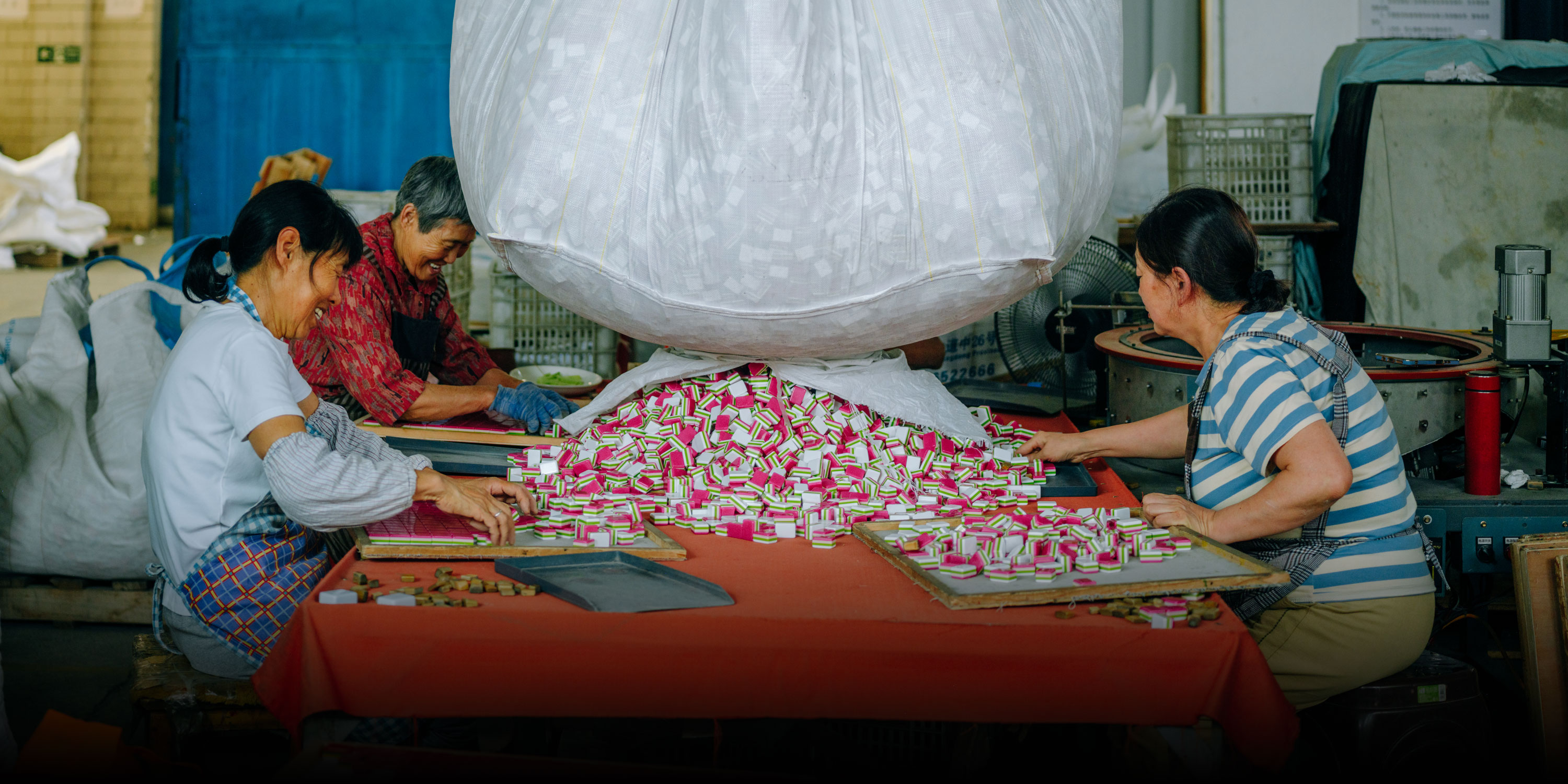
At the center of the workshop, a giant white sack hangs above a mound of acrylic tiles. Zhu’s parents, both in their 80s, sit on opposite sides of the pile, lifting the pieces one by one and arranging them into neat rows, every face turned in the same direction. Their hands move with a steady, practiced rhythm.
They work from 8 a.m. to 6 p.m., the same hours as the factory’s other employees.
“I can do 100 sets a day,” Zhu’s father says. “Workers’ wages aren’t cheap. At least the two of us can save a few hundred yuan.”
A few steps away, Jin Guihua, 62, sorts black tiles before they are colored. Their engraved patterns are barely visible against the dark surface, so she lifts each rack toward the window, tilting it until the light catches the shallow lines.
She scans the rows for matching designs, tapping each selected tile against the edge of the table before setting it aside. Sometimes she checks more than five tiles before finding the next match.
Jin once sorted about 150 sets a day. The smaller tiles and changing patterns of American mahjong have reduced her output to about 60.
“The designs are more complicated and harder to identify,” she says.
Brand new
This past March, five young entrepreneurs arrived in Taixing to start a mahjong business.
A few minutes from Zhu’s family-run factory, they turned a village house into a workshop. Machines occupied the ground floor; their bedrooms were upstairs. There were no fixed hours or weekends.
Between them, the five had experience in sales, technology, and international trade. None had ever made a mahjong tile.
Li Mingzhi, 30, leads the venture, which operates under the name SenJoy Mahjong. A former Alibaba employee, he saw American mahjong as a chance to sell a higher-value product overseas. He recruited his former colleague Wang Hao, his younger brother, and several childhood friends from northwestern China’s Gansu province to build the venture.
“I never imagined I’d move to such a remote village to start a business,” says Wang, 28.
Zhu estimates that nearly 30 new factories have sprung up in Taixing over the past year as entrepreneurs rush into American mahjong. The town’s fragmented supply chain has allowed outsiders to enter without building a factory from scratch.
“Here, you don’t need to build an entire production line yourself,” Li tells Sixth Tone. “You can outsource each step and focus on design and branding.”
In practice, however, the workshop became a crash course in manufacturing.
“Every day is unpredictable,” Li says. “Customers can call at any time, and problems can emerge at every stage — production, design, communication, quality inspection. Working until 3 or 4 a.m. is normal.”
The new equipment offered precision but no ready-made solution for mahjong production: sizes varied, hand-cut pieces did not match machine-cut ones, and every fault required another round of testing.
“Almost every step brought a different problem,” Wang says.
The UV printer proved especially difficult. Each design had to be aligned by hand, and a shift of just 1 millimeter could push the ink outside the engraved lines.
The night before Sixth Tone’s visit, all five stayed up until 3 a.m. trying to solve the problem. “Before entering the industry, I thought making mahjong would be simple,” says Wang. “Once I started, I realized American sets are closer to handicrafts.”
Despite the setbacks, the team produced and sold about 1,000 sets in its first few months, generating roughly 230,000 yuan in sales. Its customers included businesses selling on Amazon.
Li put 1.5 million yuan of his own savings into the venture. “Based on our current orders,” says Li, “we expect the business to recover that investment within six months.”
To avoid becoming another contract manufacturer in Taixing’s crowded supply chain, the team began working with outside designers to develop original sets. It also launched an independent website and overseas social media accounts.
“For us, building a brand starts with original design,” Li says. “We might become the first company in Taixing — and perhaps one of the first in China — to build a real mahjong brand instead of simply manufacturing for others.”
The team hopes to reach buyers directly through social media, influencers, online sellers, and brick-and-mortar retailers.
Their bestseller uses a coral-reef theme. Against a shimmering blue base, coral motifs represent bamboo tiles, shells stand in for circles, and small fish serve as jokers.
“As long as the designs aren’t ugly, we’re not worried about sales,” Li says. “Right now, demand far exceeds supply.”
Wang is more cautious. Today’s buyers, he says, remain a relatively small group with strong spending power. If American mahjong reaches a broader market, more manufacturers will follow, he says, adding: “Price wars are unavoidable.”
Hua, one of the first Chinese traders to bet on American mahjong, has watched competitors multiply within months.
When she launched the business, Hua handled every part of the operation herself, often staying up late to respond to customers in the U.S. and sleeping as little as two hours a night. Today, her Ningbo-based company employs about 10 people and provides customer service around the clock.
But the market that once seemed wide open has become more crowded. Designs that once sold out quickly are now easier to source, and more suppliers are competing for the same orders.
“The conversion rate isn’t as good as before,” Hua says. Her sales data show that fewer visitors become inquiries, and fewer inquiries turn into confirmed orders.
“The profit margins were much higher in the beginning, but now they have dropped significantly,” she says. “I think this is probably an inevitable stage for any viral product.”
She, too, has started developing designs of her own.
Last month, she began experimenting with AI to create early concepts before working with freelance designers to refine them. Her first ideas included themes inspired by witches, tennis, flowers, and Christmas.
Editor: Apurva.
(Header image: Workers sort uncarved and unpainted mahjong tiles at Zhu Ronggen’s factory in Taixing, Jiangsu province, June 2026. Wu Huiyuan/Sixth Tone)